




In a world where cyber threats evolve every day, the ability to anticipate and prioritize risk is essential. The Common Vulnerability Scoring System (CVSS) is a universal standard used to assess the severity of IT vulnerabilities. Since its creation in 2005, CVSS has gone through several versions to keep up with the growing needs of cybersecurity professionals.
Two complementary ratings have gradually emerged to add a new perspective: CISA's Known Exploited Vulnerabilities (KEV) catalog and the Exploit Prediction Scoring System (EPSS).
The Exploit Prediction Scoring System (EPSS) estimates the probability that a software vulnerability will be exploited. It helps prioritize vulnerability remediation more effectively. Unlike other industry standards that capture a vulnerability's intrinsic characteristics and provide severity measures, EPSS stands out by assessing the threat using current threat intelligence from CVEs and real-world vulnerability exploitation data.
The EPSS model produces a probability score between 0 and 1 (0% to 100%), where a higher score means a greater likelihood that the vulnerability will be exploited. EPSS is considered an emerging standard developed by a volunteer group of researchers, practitioners, academics and government staff.
To provide near-real-time assessment of all publicly disclosed vulnerabilities, the EPSS SIG (Special Interest Group) is working to mature its data collection and analysis. That means building partnerships with data providers and setting up infrastructure to offer a publicly accessible interface for EPSS scores. The most critical data identifies cases where vulnerabilities have actually been exploited. This information can be collected from many sources, including intrusion detection systems, honeypots, network observation, malware analysis and other specialized sensor networks.
The main goal of the Exploit Prediction Scoring System (EPSS) is to better prioritize which vulnerabilities to fix, based on the real risk of exploitation. In other words, EPSS helps identify vulnerabilities that aren't just theoretically dangerous, but are likely to be actively exploited by attackers.
The system uses a data-driven model that combines current threat intelligence with historical vulnerability exploitation data. The EPSS score is especially useful for organizations that manage a large number of vulnerabilities and need to focus on the most critical ones for their environment.
EPSS (Exploit Prediction Scoring System) helps you understand risk by giving each vulnerability a probability score, expressed as a number between 0 and 1 (equivalent to 0% to 100%). This score is calculated with a predictive model that takes into account factors such as threat trends, historical exploit data and how critical the vulnerability is.
A higher score means a greater likelihood that the vulnerability will be exploited in the future. For example, a score of 0.8 or 80% indicates a high risk of exploitation, while a score of 0.1 or 10% suggests a low risk. Based on these scores, users can identify and prioritize the vulnerabilities that need immediate attention, so they can respond to potential threats faster and more effectively.
EPSS is therefore a valuable assessment tool for decision-making. It turns the complexity of vulnerabilities into a simple, understandable measure, so remediation resources can be allocated more effectively. It contributes significantly to strengthening an organization's overall security posture.
The KEV (Known Exploited Vulnerabilities) catalog is an initiative of the US Cybersecurity and Infrastructure Security Agency (CISA). It's a publicly accessible database listing software vulnerabilities that have been actively exploited by malicious actors.
The list is updated regularly, giving users a reliable resource for spotting critical security flaws.
It's an essential tool for proactively detecting and preventing cyberattacks. With the KEV catalog, companies can allocate their resources better and improve their overall security posture by focusing primarily on known, exploited vulnerabilities.
The KEV catalog is a central reference source for known vulnerabilities that have been exploited maliciously. By shining a light on these vulnerabilities, it guides organizations in focusing their remediation efforts. This approach makes vulnerability management more efficient and improves preparedness against cyberattacks.
Vulnerabilities are listed by vendor, product and date, with a detailed description of the flaw and the recommended remediation steps.
KEV's goal is therefore to make data on exploited vulnerabilities accessible and actionable, to improve protection against cyberattacks and make risk management easier.
The CISA KEV catalog plays a crucial role in understanding cybersecurity risk. It helps organizations identify vulnerabilities that have been actively exploited and understand the context in which that exploitation happens.
It works in several steps:
1. Identifying exploited vulnerabilities.
KEV provides a list of vulnerabilities known to have been exploited by malicious actors.
2. Prioritizing remediation efforts.
A vulnerability listed in KEV carries a high risk of being exploited again. KEV therefore helps organizations prioritize their remediation efforts.
3. Putting threats in context.
Each KEV entry includes details on how the vulnerability was exploited, along with information on known malicious campaigns. This gives organizations a better understanding of the methods cybercriminals use and the types of attacks they may face.
4. Applying mitigations. KEV also provides recommendations on mitigations and available patches.
Vulnerability management depends on effective prioritization, so efforts can focus on the most critical threats. Combining KEV (Known Exploited Vulnerabilities) and EPSS (Exploit Prediction Scoring System) strengthens this approach with a contextual view based on the likelihood of exploitation.
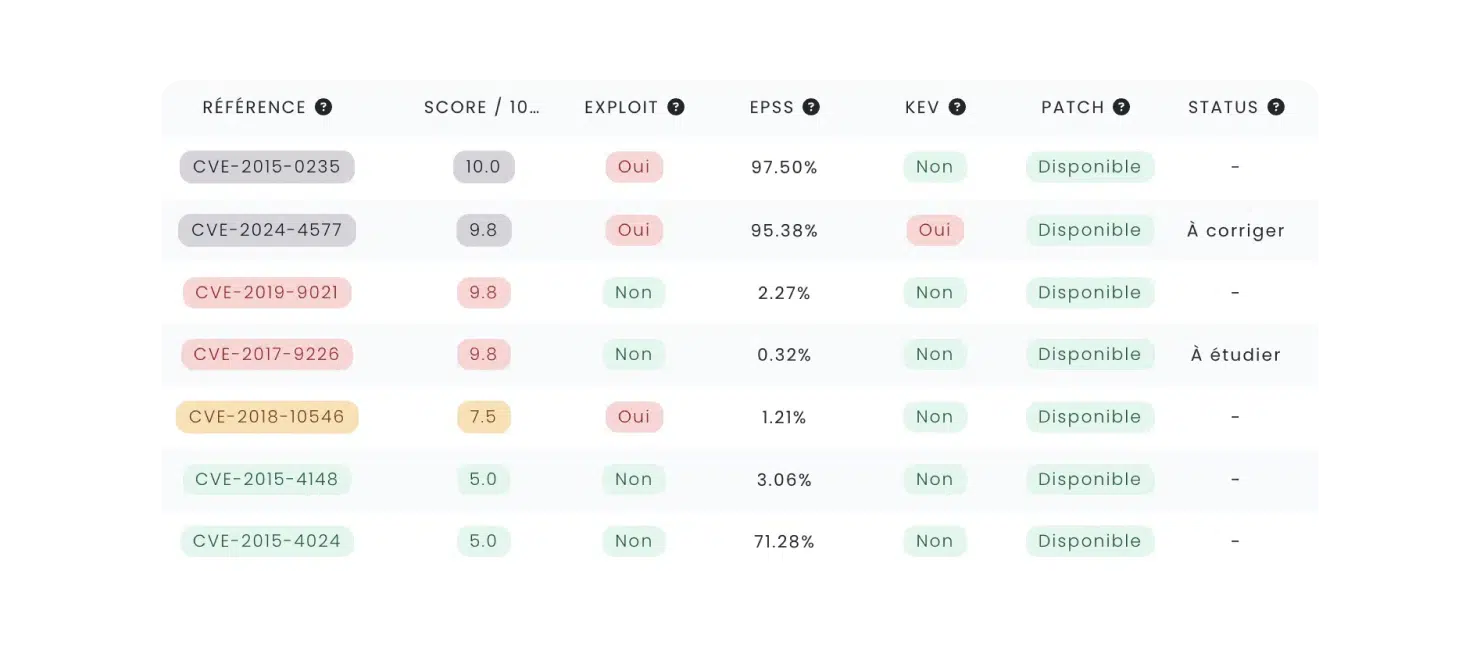
KEV plays a key role by providing detailed context on actively exploited vulnerabilities. Each entry in the catalog includes precise information on the exploitation context, such as the methods attackers use, associated malicious campaigns and recommended fixes. This level of detail lets organizations focus immediately on the most relevant threats and act quickly to limit the risk of repeated exploitation.
With KEV, vulnerabilities that have already been exploited are immediately flagged as priorities.
EPSS, for its part, adds a forward-looking perspective that complements KEV with a predictive view. Using historical and current data along with advanced statistical models, EPSS gives each vulnerability a probability score (from 0 to 1) indicating its risk of future exploitation. This helps identify emerging threats that, while not exploited today, could become critical in the near future.
With EPSS, vulnerabilities with high potential risk are brought to light, so you can anticipate attacks.
By combining the strengths of KEV and EPSS, organizations get not only an accurate picture of where they stand, but also a contextual roadmap for anticipating and effectively addressing vulnerabilities, strengthening their overall security posture.
For example:
• A vulnerability listed in KEV with a high EPSS score becomes a top priority.
• A flaw not listed in KEV and with a low EPSS score can be placed under monitoring without an immediate fix.
By combining these two approaches, organizations adopt a balanced remediation strategy based on reliable, up-to-date data.
This methodology lets you:
• Respond faster to critical vulnerabilities.
• Anticipate future exploitation with insights from predictive models.
• Take a proactive approach to IT security.
By integrating KEV and EPSS, companies significantly improve their security posture, limit their exposure and align vulnerability management with real-world threats.
Log4Shell (CVE-2021-44228) is a critical vulnerability in the Log4j library used by many applications, discovered in December 2021. It was immediately added to the KEV catalog because active attacks were observed as soon as it was disclosed. Attackers used the flaw to execute remote commands and compromise critical systems in sectors ranging from healthcare and finance to critical infrastructure.
CVE: CVE-2021-44228 (Log4Shell)
CVSS score: CVSS v3.1 base score: 10.0 (maximum severity). Critical impact on system confidentiality, integrity and availability.
KEV: Added to KEV immediately because of active attacks observed from disclosure. Used to execute remote commands and compromise critical systems in sectors such as healthcare, finance and critical infrastructure.
EPSS: Initial score above 0.95 (95%), indicating a very high likelihood of exploitation. Predictions based on predictive models and historical data.
Combined result: The Log4Shell case shows how the CVSS score, combined with KEV and EPSS, provides a complete view of a vulnerability's severity and urgency.
• The CVSS score highlights the flaw's intrinsic severity.
• KEV confirms whether the vulnerability is being actively exploited, with factual information.
• EPSS assesses the likelihood of future exploitation, enabling proactive prioritization.
Vulnerability management can no longer rely on static assessments based only on technical metrics. Combining the CVSS score, KEV and EPSS gives a complete, dynamic view for prioritizing security efforts effectively.
By combining these tools, organizations can turn vulnerability management into a proactive, contextual approach. This synergy lets them respond quickly to current threats and rank vulnerabilities that could become critical, while optimizing how resources are allocated.
Explore our guides and analysis on current threats.