



Your vulnerability scanner just flagged 847 alerts. 312 are labeled "Critical" or "High". Your team has the capacity to handle 20 of them this week. Where do you start?
If your answer is "with the ones with the highest CVSS score", you're confusing prioritization with classification. At least, that's the message from CISA.
On June 10, 2026, CISA (the Cybersecurity and Infrastructure Security Agency, the US federal cybersecurity agency) issued Binding Operational Directive 26-04, a mandatory directive that applies to all US federal civilian agencies. For the first time, a government has dropped the CVSS score as the basis for deciding which vulnerabilities to fix first. This isn't a technical detail. It's a signal to the entire industry.
CVSS (Common Vulnerability Scoring System) gives every vulnerability a score from 0 to 10. Simple, universal and adopted everywhere. For years, that was enough.
Here's the core problem: CVSS scores don't reflect real-world exploitability or the specific impact on your environment. A vulnerability rated Critical can pose minimal risk if the affected component runs in an isolated network segment. Conversely, a medium-severity vulnerability in an internet-facing application can be your most urgent risk.
A real example shows this gap perfectly. CVE-2025-13956 is a missing authorization flaw in LearnPress, a WordPress plugin. CVSS score: 5.3, rated "Medium". Under pure CVSS logic, it sits in the backlog indefinitely behind dozens of theoretically more severe vulnerabilities. Yet after being published in March 2025, it stayed quiet for more than a year before active exploitation was detected in April 2026, with 168 attacking IPs identified and attacks aimed at full takeover. A CVSS score of 5.3, but a real-world risk at critical level for any exposed organization.
A CVSS 9.8 on a niche product with no attacker tooling available is potentially less urgent than a CVSS 7.5 on a widely deployed perimeter device that's already being exploited at scale.
This gap was tolerable as long as volumes stayed manageable. That's no longer the case. More than half of published CVEs are scored High or Critical. If everything is critical, nothing is. Meanwhile, only 26% of vulnerabilities in the KEV catalog were fully remediated in 2025, down from 38% the year before.
Teams are wearing themselves out chasing high scores while the real threats move forward.
BOD 26-04 supersedes and revokes two earlier directives: BOD 19-02 on remediating internet-accessible systems, and BOD 22-01 on known exploited vulnerabilities. Federal agencies are no longer required to use CVSS to prioritize their vulnerabilities.
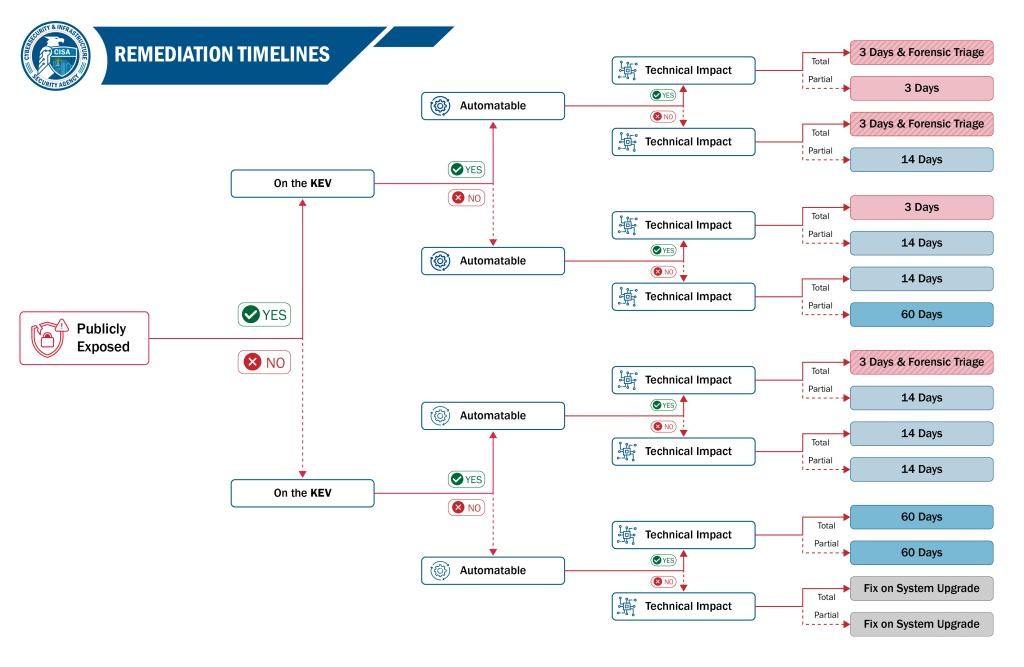
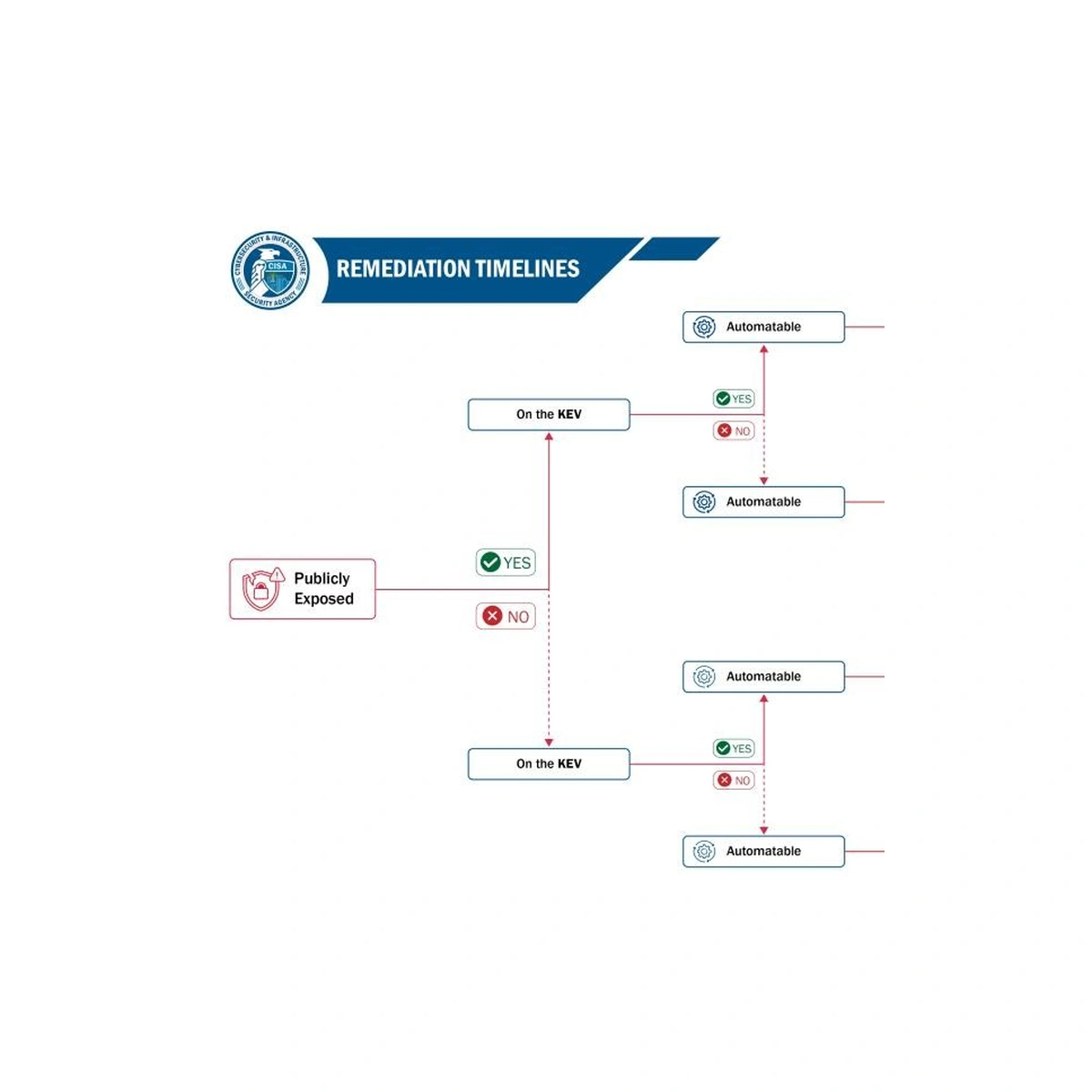
Instead, four variables determine remediation urgency:
The combination of these four variables sets the mandatory deadline for fixing the vulnerability:
The last tier matters as much as the first: a vulnerability with no exposure, no confirmed exploitation and no total impact can legitimately wait for the next update cycle. Patch less, but patch better: that's now official doctrine.
BOD 26-04 is formally binding only on US federal civilian agencies. But its impact reaches far beyond that scope.
CISA's previous major directive, BOD 22-01, created the KEV catalog and became a de facto standard in the private sector worldwide, adopted by security teams and auditors. BOD 26-04 is its direct successor.
For a European organization, there are three concrete implications:
Three shifts in posture are needed, whatever regulations apply to you.
Do you know exactly which assets you're exposing right now? That's the first question BOD 26-04 asks, and the hardest one for most organizations.
Our EASM module continuously maps all of your internet-facing services. Every subdomain, port and technology is discovered automatically and updated in real time. When an asset goes from internal to exposed, you know immediately: that's your answer to the first variable of the BOD 26-04 model.
For prioritization, Activ Security cross-references every vulnerability with the three signals the directive formalizes: CVSS for base severity, EPSS for the likelihood of exploitation in the next 30 days, and KEV for confirmed active exploitation. The result is a list of actions prioritized by real-world risk.
And while your teams work through those priorities, our WAF protects your applications in real time, without waiting for the next patch 🛡️
Explore our guides and analysis on current threats.